Sending funds privately
Alice needs to pay her subcontractor, Bob, who also uses Curvy, for the services he provided.
Bob has a registered Curvy ID: bob.curvy.name
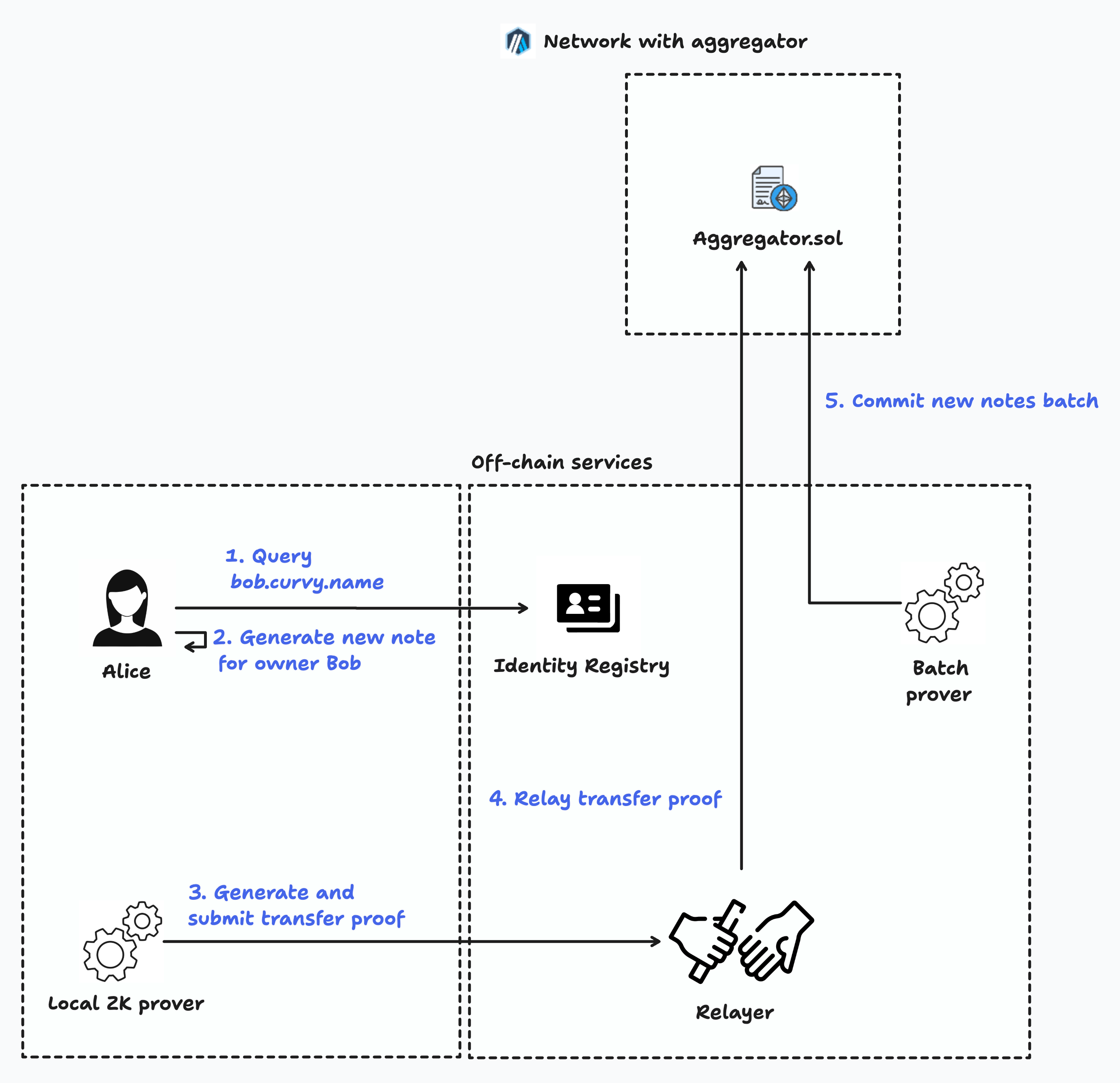
Steps explained in detail
🔵 Alice
1. Alice queries bob.curvy.name in the Identity Registry, fetching Bob's public keys.
2. Using the Curvy SDK, a new note is created for which Bob is the owner. This information is hidden from everyone except Alice and Bob.
3. The Local ZK prover, running entirely on Alice's device, generates a transfer proof that spends Alice's notes and creates the new output note owned by Bob. The proof is submitted to the Relayer, so Alice needs no gas tokens or on-chain identity.
⚫ Curvy
4. The Relayer relays the transfer proof on-chain to Aggregator.sol, which verifies it and marks the spent notes' nullifiers.
5. The Batch Prover constructs a commitment proof for the new notes batch and commits it on-chain to Aggregator.sol. After successful verification, Bob's new note becomes part of the committed Notes tree.
🟢 Bob
6. Some time later, after logging into the Curvy App, Bob's Curvy SDK syncs its local Merkle tree from the Indexer and simultaneously scans the notes for ownership, detecting his new balance.
NOTE
The equivalent actions also appear in the full protocol drawing, where they use the combined flow's numbering. Steps 2 and 3 are specific to this flow.
IMPORTANT
Although this is the simplest process in Curvy, it is also the most private, as the exact: amount, currency, sender and recipient are completely hidden from the public eye.