Unshielding funds privately
After some time and many privately and securely received payments from his clients, Bob is ready to sell a portion of his crypto on a centralized exchange (CEX) to buy a house.
In the previous scenarios, we covered the first two of the three actions of Aggregator.sol: shielding and aggregation.
Now we will need the third one: unshielding.
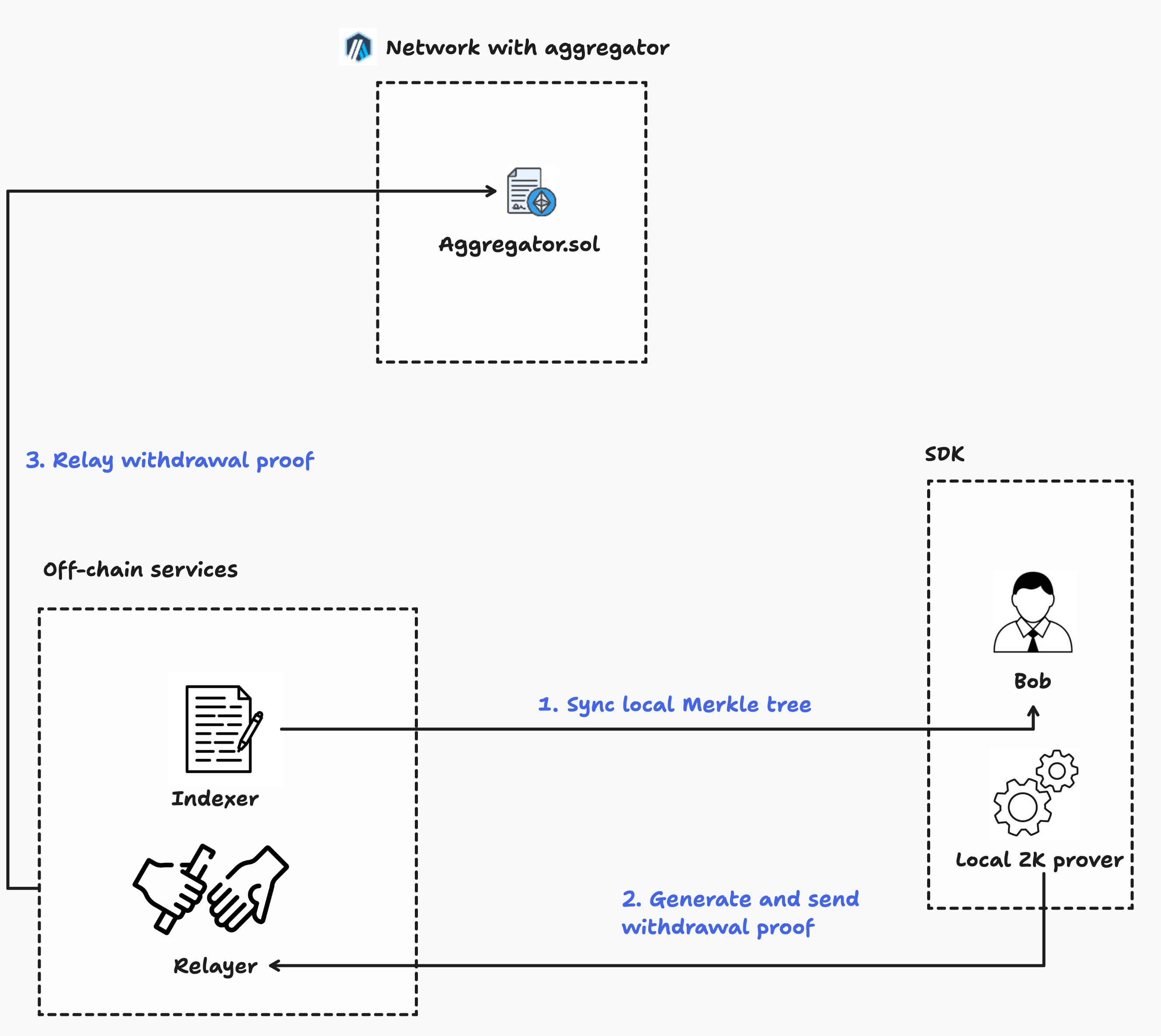
Steps explained in detail
🟢 Bob
1. Bob's Curvy SDK syncs its local Merkle tree from the Indexer and scans the notes to match the ones in his ownership, decrypting their balances and exact tokens.
2. The Local ZK prover, running entirely on Bob's device, generates the withdrawal proof — aggregating multiple notes into a single one if needed — with the CEX's address as the withdrawal destination, and sends it to the Relayer.
⚫ Curvy
3. The Relayer relays the withdrawal proof to Aggregator.sol, submitting the withdrawal request on-chain. After verifying the proof, Aggregator.sol automatically transfers the funds from itself to the Centralized Exchange's address.
IMPORTANT
From the perspective of an on-chain observer, funds have simply moved from Aggregator.sol to the CEX's address. The information about the previous owner of the funds, and the notes themselves that were aggregated into a single note for unshielding, is completely hidden.